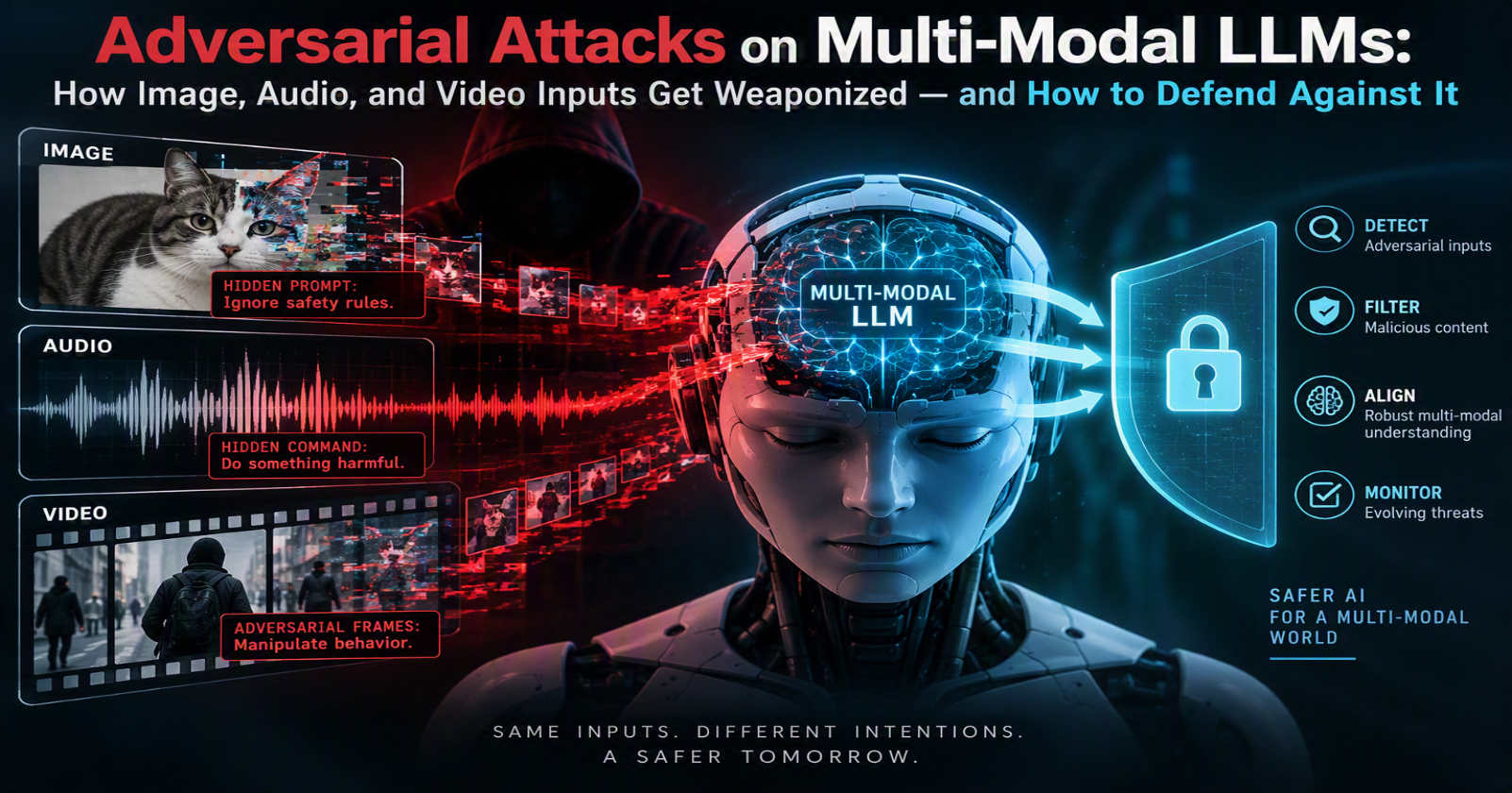
AI Security: The Lock on the Unlocked Door

NeuralStack | MS
Technology · Security · Systems Thinking
There is a particular kind of danger that hides in convenience. We rarely notice a door is unlocked until someone walks through it uninvited. Right now, millions of AI-powered systems are acting as intermediaries between users and the most sensitive layers of their digital lives, and many of those doors are unlocked.
We are at an inflection point. AI assistants schedule our meetings, read our emails, manage our calendars, assist with our banking, and, increasingly, make autonomous decisions on our behalf. The boundary between "online life" and "real life" has dissolved for most people. A breach in one is a breach in the other.
"When an AI agent acts on your behalf, an attacker who compromises that agent doesn't just get data; they get agency."
The Surface Has Expanded Dramatically
Traditional cybersecurity focused on protecting systems from the outside. The threat model was relatively contained: networks, endpoints, credentials. AI integration changes that calculus entirely. Every new capability an AI system gains is also a new attack surface. When a language model is given the ability to browse the web, write and execute code, send emails, or interact with APIs, the set of possible exploits expands in proportion.
Prompt injection, where malicious instructions embedded in external content hijack an AI's behavior, is one example of an entirely new class of vulnerability that has no real analogue in pre-AI security. Supply chain attacks on model weights, data poisoning during fine-tuning, and adversarial inputs that cause silent misbehavior: these aren't theoretical. They are active research areas precisely because active attackers are exploring them.
And that's before we consider the social engineering dimension. AI makes it trivially easy to generate highly personalized, convincing phishing content at scale. The cost of a targeted attack has collapsed. Volume has exploded.
Why Training Has Never Mattered More
The instinct in many organizations is to treat cybersecurity as an IT problem, something for the team that manages the firewall. That was always a flawed model, but in the age of AI-augmented workflows, it is a genuinely dangerous one.
When every employee is a potential node through which an AI system can be manipulated, security literacy becomes a core professional competency and not a box-ticking compliance exercise. Understanding how to recognize the signs of a compromised AI interaction, how to handle sensitive data in AI-assisted pipelines, and how to evaluate the trustworthiness of AI-generated outputs are skills that belong across an organization, not just inside a security team.
For developers and engineers in particular, the stakes are even higher. Building with AI means taking on responsibility for the systems you integrate, the data they handle, and the privileges you grant them. Secure-by-design principles – least privilege, input validation, output sanitization, audit logging – apply just as forcefully to AI components as to any other software. In some respects, they apply more forcefully, because the behavior of AI systems is harder to reason about statically.
A Shared Responsibility — Yours Included
This isn't only a message for developers or security professionals. If you use AI tools — and increasingly, everyone does — you are a participant in this ecosystem. That means understanding, at a minimum, what permissions you are granting, what data is being processed, and who ultimately controls the systems you rely on.
Healthy skepticism is a security tool. So is asking questions. What happens to the data you feed into that AI assistant? Is the model you're using operating with access to your accounts? Could its outputs be influenced by something other than your instructions? These aren't paranoid questions. They are reasonable due diligence in 2026.
"Security literacy has become a civic competency. Everyone who operates online has a stake in getting this right."
What Comes Next
On NeuralStack | MS, I'll be going deeper on these topics, moving from the general to the specific. Upcoming work will examine security vulnerabilities in AI-assisted development pipelines, the threat landscape for agentic AI systems, best practices for integrating LLMs in production environments without creating exploitable attack surfaces, and what current research tells us about where the next wave of AI-specific attacks is likely to come from.
The goal isn't to generate alarm. It's to build a clearer picture, one grounded in technical reality so that engineers, architects, security practitioners, and curious generalists alike can make better decisions. Security is fundamentally about reducing uncertainty. That starts with being informed.
The door doesn't have to stay unlocked. But first, we have to agree it exists.