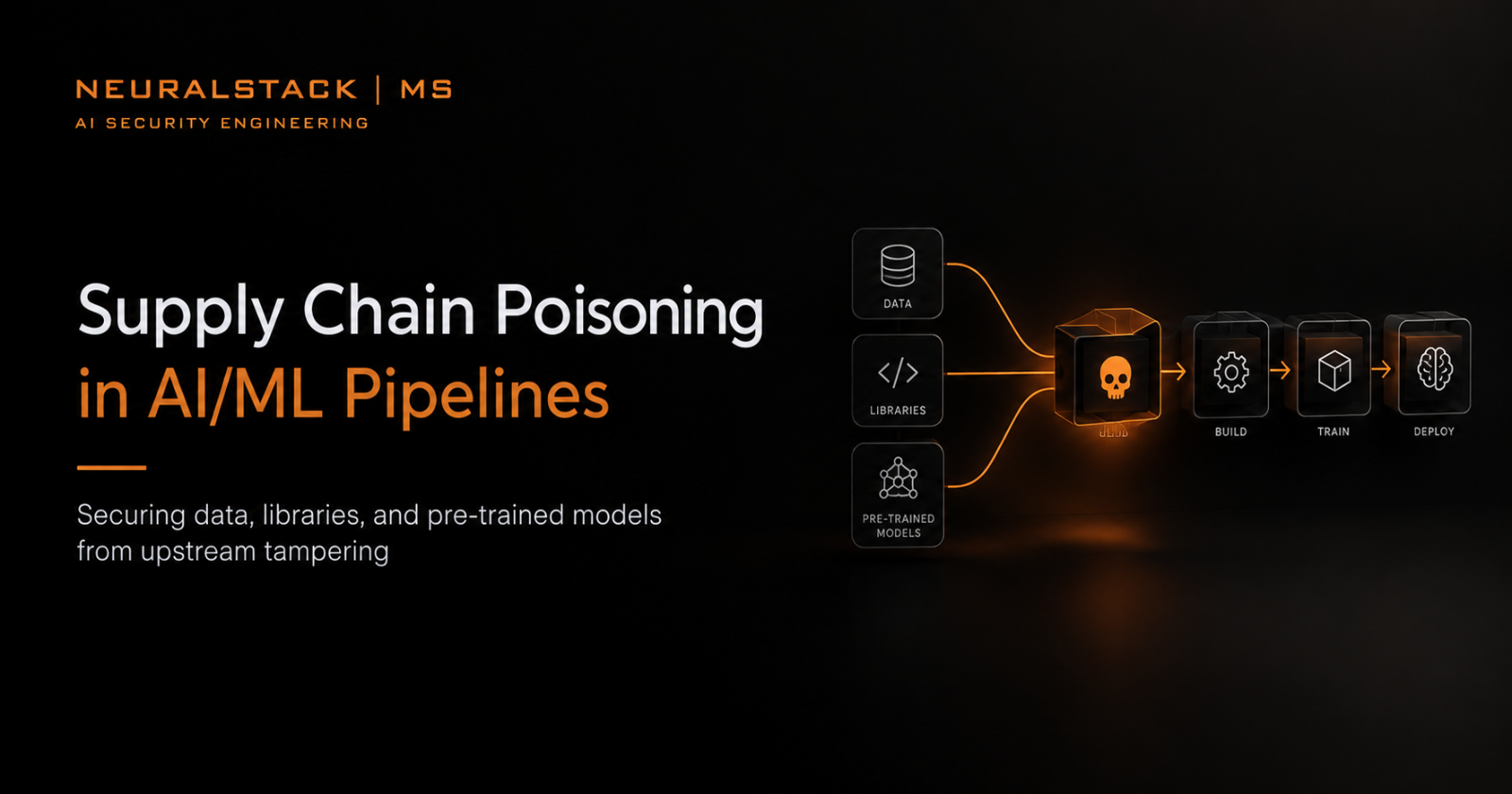
The Hidden Attack Surface of Vector Databases

NeuralStack | MS Tech Blog – Databases & Data Engineering in AI Security Engineering, Part 2 of 4
A New Storage Primitive, A New Threat Model
Vector databases emerged as a distinct infrastructure category alongside the rise of large language models and semantic search. Systems such as Pinecone, Weaviate, Chroma, Qdrant, Milvus, and the pgvector extension for PostgreSQL have become load-bearing components of production AI architectures – the persistent stores that underpin retrieval-augmented generation (RAG), semantic search, recommendation systems, and long-term agent memory.
They are also, in the security community's estimation, poorly understood as attack surfaces. Most security literature treats the vector database as a black box that sits between embedding generation and retrieval, inheriting whatever access controls the surrounding application enforces. This framing misses several threat vectors that are structurally unique to the embedding-based retrieval paradigm.
This article maps the threat model of vector databases in depth: the attacks that are specific to embedding stores, the vulnerabilities that arise from their architectural properties, and the controls that practitioners should implement.
How Vector Databases Work: A Security-Relevant Summary
To reason about the attack surface, a brief architectural summary is necessary.
A vector database stores high-dimensional numerical vectors – typically 768 to 4096 floating-point dimensions – alongside associated metadata and, in some implementations, the original source documents. Vectors are generated by an embedding model (e.g., OpenAI text-embedding-3-large, Cohere embed-v3, or a locally hosted all-MiniLM-L6-v2) and indexed using approximate nearest-neighbour (ANN) algorithms: HNSW (Hierarchical Navigable Small World), IVF (Inverted File Index), or LSH (Locality-Sensitive Hashing).
At query time, an incoming query is embedded using the same model, and the index is searched for vectors within a threshold cosine similarity or Euclidean distance. The retrieved vectors and their associated metadata or documents are returned to the calling application, typically to be injected into an LLM prompt as context.
This architecture introduces several properties that are security-relevant:
Similarity is the access mechanism: Retrieval is governed by geometric proximity in embedding space, not by explicit identifiers. There is no equivalent of a SQL
WHERE id = ?guard at the retrieval layer.Metadata is stored alongside vectors: Most vector databases store arbitrary key-value metadata with each vector. This metadata is frequently rich – containing source document identifiers, user IDs, timestamps, classification labels, or access control tags – and is returned at query time.
Embeddings are approximate representations: The compression of semantic content into a fixed-size vector introduces information-theoretic properties that can be exploited for extraction and manipulation.
Multi-tenancy is often an afterthought: Many vector database deployments begin as single-tenant and grow into multi-tenant architectures without the access control model being redesigned for that transition.
Threat Vector 1: Adversarial Embeddings
Adversarial embeddings are vectors crafted to exploit the geometry of the embedding space – specifically, to cause a retrieval system to return results that the attacker intends rather than results the system's designers intended.
Nearest-Neighbor Poisoning
An attacker with write access to a vector index can insert adversarially crafted vectors that, when retrieved as nearest neighbors, inject malicious content into the application context. This is the embedding-space equivalent of data poisoning at the ingestion layer, but it operates at retrieval time and requires no access to the embedding model or training infrastructure.
The practical attack proceeds as follows:
The attacker identifies a query pattern of interest – for example, questions about a specific topic that the AI application is expected to handle.
The attacker generates an embedding for adversarially crafted content (e.g., a document containing a prompt injection payload, misinformation, or instructions that override the application's system prompt).
The attacker inserts this vector into the index such that it is within the similarity threshold of the expected query embeddings.
At query time, the adversarial vector is retrieved as a top-k result and its associated content is injected into the LLM context.
This attack is particularly effective because:
The injected vector appears legitimate to the retrieval system – it is close to the query in embedding space by design
Standard logging, which records query results by vector ID, may not surface the injected content as anomalous
The attack is durable: the adversarial vector persists in the index until explicitly removed
Mitigation: Implement write-path authentication and authorization that restricts index insertions to verified, trusted sources. Apply content scanning to documents at the time of embedding generation, before vectors are written to the index. Log full document content retrieved at query time, not just vector IDs.
Cross-Encoder Reranking as a Partial Defence
Many production RAG systems implement a two-stage retrieval: a fast ANN search (first-stage retrieval) followed by a cross-encoder reranker (second-stage) that scores retrieved candidates against the original query with higher accuracy. Cross-encoder rerankers are substantially harder to fool with adversarial embeddings because they operate on the raw text content rather than the compressed vector representation.
While not a complete defense, an attacker with knowledge of the reranker can craft content that scores highly on both stages; cross-encoder reranking meaningfully raises the cost of embedding-space attacks.
Threat Vector 2: Embedding Inversion and Data Extraction
Embedding inversion refers to techniques that reconstruct the original text from its vector representation. This is an active research area with practical implications for data privacy in vector database deployments.
Why Embedding Inversion Matters
Consider an organization that stores embeddings of proprietary internal documents in a vector database and exposes a semantic search API internally or externally. If an attacker can extract the raw vectors (through a direct API call, a misconfigured export, or a backup exfiltration), they may be able to partially reconstruct the original document content from those vectors alone, without ever accessing the document store.
Research has demonstrated that transformer-based embedding models retain sufficient information about their input text that reconstruction attacks are non-trivial. Work on Vec2Text and similar approaches has shown that, under certain conditions, original text can be recovered from embeddings with meaningful fidelity, particularly for shorter text chunks (under 128 tokens) where the information density is high relative to the dimensionality of the embedding.
Practical Implications
The security implication is clear: raw embedding vectors should be treated as sensitive data, not as opaque numerical artifacts. Specific controls follow:
Encrypt embeddings at rest using envelope encryption. The encryption key should be separate from the key used to protect the source documents.
Apply differential privacy to embedding vectors before storage if the reconstruction risk of the source documents is high. Libraries such as OpenDP provide implementations suitable for use in data pipelines.
Restrict vector export APIs. Most vector database management interfaces expose bulk export functionality for backup and migration purposes. These endpoints should be subject to the same access controls as the underlying document store.
Do not store source documents in the vector database. Maintain a separation between the vector index (which stores embeddings and lightweight metadata) and the document store (which stores the source content). This limits the blast radius of a vector database compromise.
Threat Vector 3: Similarity Search Exploitation
The approximate nearest-neighbor search algorithms that power vector databases introduce their own security-relevant properties, distinct from the semantic content of the stored vectors.
Index Probing for Document Reconstruction
An attacker with query access to a vector database, but not direct read access to stored vectors or documents, can probe the index systematically using crafted query vectors to infer the content of stored embeddings. By observing which vectors are returned as nearest neighbors for a sequence of query vectors, the attacker builds a map of the embedding space and can triangulate the approximate position of stored vectors.
This approach is analogous to timing side-channel attacks in cryptography: the attacker extracts information not by reading protected data directly but by making inferences from the system's observable behavior in response to controlled inputs.
Mitigation: Rate-limit query APIs. Implement query result perturbation – adding controlled noise to similarity scores – so that precise triangulation is not feasible. Log and alert on query patterns that systematically vary a single dimension of the query vector, which is a signature of probing behavior.
HNSW Graph Traversal Attacks
HNSW indexes construct a multi-layer graph where nodes represent vectors and edges represent approximate nearest-neighbor relationships. Some implementations expose graph traversal metadata – entry points, layer membership, edge weights – through diagnostic or administrative APIs. An attacker with access to this metadata can significantly reduce the search space required for the probing attack described above, because the graph structure reveals structural information about the embedding space.
Audit administrative API endpoints of vector database deployments for unnecessary exposure of index internals. Disable or restrict diagnostic endpoints in production deployments.
Threat Vector 4: Multi-Tenancy and Namespace Isolation Failures
Multi-tenant vector database deployments – where multiple users, teams, or clients share a single index or cluster – introduce access control requirements that differ structurally from those of relational databases.
The Namespace Isolation Problem
Most vector databases implement tenancy through namespace or collection isolation: each tenant's vectors are stored in a separate namespace, and query operations are scoped to a namespace. The security assumption is that namespace boundaries are enforced at the query layer.
This assumption fails in several documented scenarios:
Misconfigured filter conditions: Many vector databases support metadata filtering – restricting retrieval to vectors matching a metadata predicate (e.g., tenant_id == "acme"). If the application layer is responsible for appending these filters to every query and a code path exists where the filter is omitted (through a code bug, a missing middleware condition, or an API version mismatch), a cross-tenant retrieval occurs.
Collection name enumeration: In systems that use human-readable collection names (e.g., acme_documents, globex_documents), an attacker who can create collections or issue queries against arbitrary collection names may be able to enumerate and query other tenants' collections if the naming convention is guessable.
Administrative API exposure: Vector databases frequently expose administrative APIs for collection management, backup, and statistics. If these APIs are accessible from the same network path as query APIs, an attacker who compromises query credentials may be able to perform administrative operations across all tenants.
Recommended Multi-Tenancy Architecture
For production multi-tenant deployments, the following architectural pattern is recommended:
One collection per tenant with separate encryption keys – do not rely solely on metadata filtering for isolation.
Enforce tenant scoping at the API gateway layer, not in application code. A dedicated middleware layer that injects tenant context into every query is more reliable than trusting individual request handlers to apply the correct filter.
Audit cross-tenant query patterns by logging the tenant context of every query and alerting on queries that touch more than one tenant's namespace within a single request.
Use separate vector database clusters for high-sensitivity tenants if the risk profile warrants it. Logical isolation is not equivalent to physical isolation.
Threat Vector 5: Metadata as an Exfiltration Channel
Vector databases return metadata alongside retrieved vectors. In production RAG systems, this metadata often includes internal identifiers, classification labels, access control tags, source document URLs, or user-attribution information. If metadata is returned directly to the end user, or injected into an LLM prompt that subsequently produces user-visible output, metadata fields become a potential exfiltration channel.
Indirect Metadata Exfiltration via LLM
An attacker who can influence the content retrieved from a vector database – through adversarial embeddings or query manipulation – may be able to cause the retrieval system to surface metadata from documents they are not authorized to access. If the retrieved metadata is then injected into an LLM prompt and the LLM summarizes or echoes that metadata in its response, the attacker has exfiltrated sensitive information without ever directly querying the vector database.
Mitigation: Implement strict metadata output filtering at the application layer. Define which metadata fields are permissible to surface in LLM prompts and in API responses, and strip all other fields before they leave the retrieval layer. Treat metadata scrubbing as a security control, not an application design preference.
Access Control: The Baseline That Is Frequently Missing
Despite the sophistication of some of the attacks described above, the most common vector database security failure in production systems is elementary: no authentication on the vector database API.
Deployed instances of Chroma, Qdrant, and Milvus are routinely discovered on the public internet with no authentication enabled. Shodan and Censys queries for the default ports of these systems return substantial numbers of exposed instances. An unauthenticated vector database is a complete data breach: all stored vectors, all associated metadata, and all source documents (if stored in the same system) are exfiltrated with a single bulk export call.
Minimum Access Control Requirements
| Control | Implementation |
|---|---|
| API key or token authentication | Enabled at the vector database level, not only at the application layer |
| Network-level isolation | Deploy vector databases in a private subnet; never expose them directly to the public internet |
| TLS for all connections | Including internal connections from application servers to the vector database |
| Role-based access control | Separate read and write roles; restrict bulk export to administrative roles only |
| Audit logging | Log every write operation with the source identity and timestamp |
Conclusion
Vector databases are not simply faster key-value stores. They are semantically aware retrieval systems with unique structural properties – approximate similarity as the access mechanism, high-dimensional compressed representations, multi-layer graph indexes – that create attack surfaces with no direct analogue in relational or document database security.
The threat model presented in this article – adversarial embeddings, embedding inversion, similarity probing, namespace isolation failures, metadata exfiltration – is not exhaustive, but it covers the highest-priority vectors for practitioners securing production RAG and semantic search deployments.
The next article in this series takes the vector database threat model upstream and examines the retrieval pipeline as a whole: how the interplay between query processing, chunk retrieval, and LLM context injection creates the conditions for indirect prompt injection and retrieval poisoning at scale.
NeuralStack | MS Databases & Data Engineering in AI Security Engineering, Part 2 of 4
Tags: #VectorDatabases #AISecurityEngineering #RAGSecurity #EmbeddingAttacks #MLSecurityEngineering #NeuralStackMS
About the author
- Programmer, Creative and Tech Nerd. I build with code, write about AI and Software Development and explore the future of intelligent Agents.
Comments
Join the discussionNo comments yet. Be the first to comment.