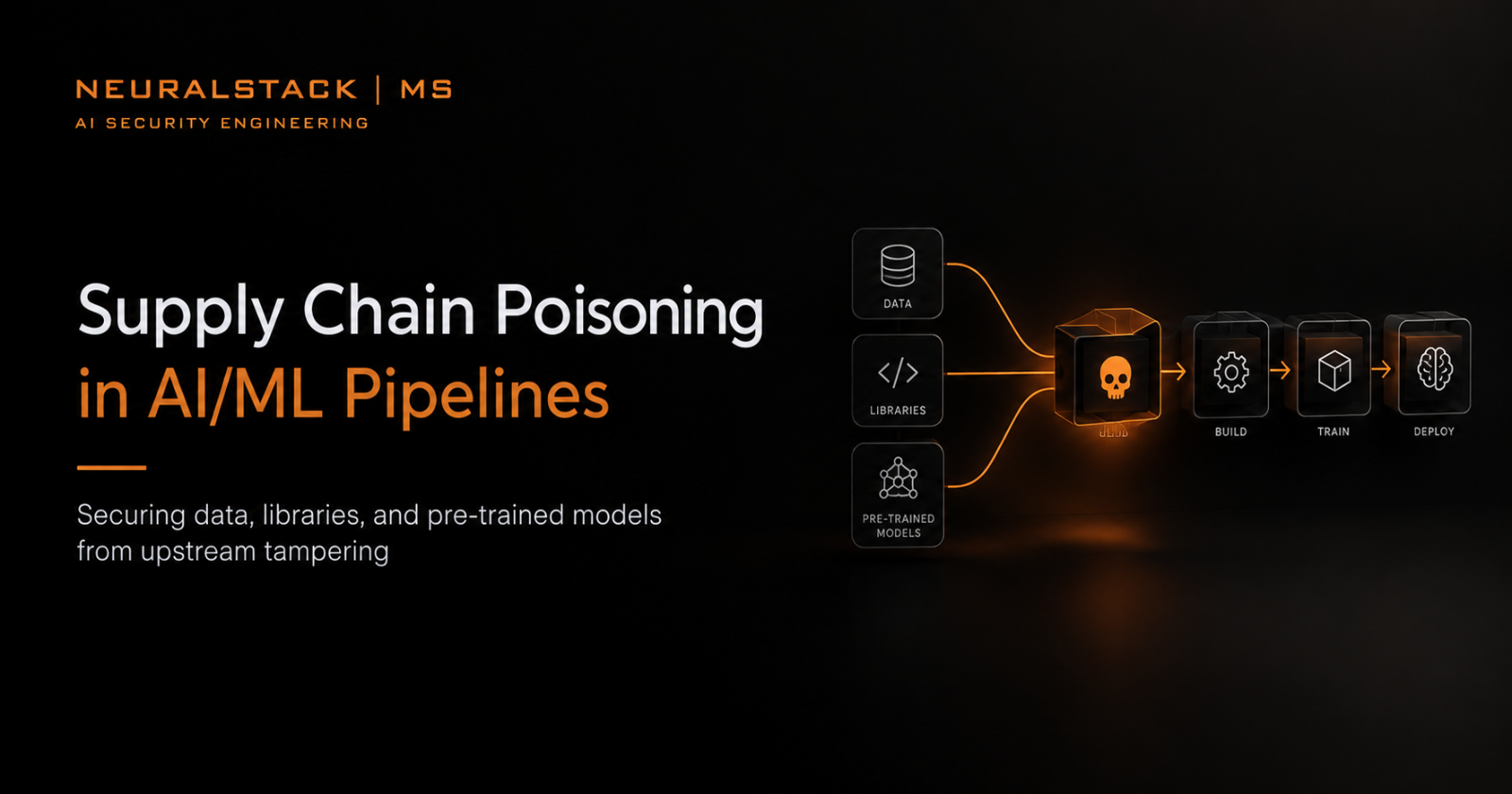
Data Ingestion Attacks & AI Pipeline Security

NeuralStack | MS Tech Blog – Databases & Data Engineering in AI Security Engineering, Part 1 of 4
The Pipeline Is the Attack Surface
In classical application security, the perimeter is relatively well-defined: a network boundary, an API gateway, an authentication layer. In AI systems, the perimeter dissolves. The model's behavior is a direct function of the data it was trained on, fine-tuned on, or retrieves at inference time. Attack the data and you attack the model – without ever touching the weights, the serving infrastructure, or the application code.
Threat Taxonomy: What Can Go Wrong at Ingestion
Before examining specific attack vectors, it is useful to establish a taxonomy. Ingestion-layer threats fall into three broad categories:
1. Data Poisoning – Introducing malicious or manipulated records into a dataset such that a model trained or fine-tuned on it exhibits adversarially desired behavior. Poisoning can be targeted (causing misclassification of a specific input) or indiscriminate (degrading overall model performance or introducing backdoors).
2. Data Integrity Attacks – Corrupting, truncating, or substituting data in transit or at rest without necessarily poisoning a training run. These attacks compromise the reliability of downstream analytics, monitoring pipelines, and feature stores rather than the model weights directly.
3. Supply Chain Attacks on Data Sources – Compromising upstream data providers, public datasets, web scraping targets, or third-party APIs before the data reaches the ingestion pipeline. The ML community's heavy dependence on open data sources makes this an especially high-value attack surface.
The ETL Pipeline as an Attack Vector
Extract, Transform, Load (ETL) and its modern ELT inversion are the circulatory systems of data engineering. For AI systems, they carry training corpora, fine-tuning datasets, retrieval documents, and real-time feature vectors. They are also, in most organizations, significantly under-secured relative to the models they feed.
Schema Injection and Type Coercion Attacks
ETL pipelines that ingest semi-structured data – JSON, Avro, Parquet, CSV – frequently rely on inferred schemas or schemas defined at the source. An attacker with write access to an upstream data source can inject fields or manipulate types to cause:
Silent type coercions that propagate incorrect numeric representations into feature vectors
Null injection that bypasses validation logic written against expected field presence
Schema drift exploitation, where pipelines that auto-migrate schemas on first encounter can be forced to ingest attacker-controlled schema definitions
Consider a pipeline ingesting JSON event logs from a third-party SaaS connector. If the connector is compromised, the attacker can introduce a new field – say, __metadata__ – that is silently ingested, stored, and later surfaced to a model via a retrieval step. If the pipeline applies no field-level allowlisting, this is a trivial vector for data injection.
Mitigation: Enforce strict schema validation at the extraction boundary using a schema registry (Confluent Schema Registry, AWS Glue Schema Registry, or a custom JSON Schema enforcement layer). Reject, quarantine, and alert on schema drift rather than auto-migrating.
Transformation Logic Tampering
The transform step is where raw data becomes model-ready. Feature engineering, text normalization, tokenization, embedding generation – all of these occur here. If transformation logic is stored in a mutable location (an S3 bucket, a Git repository with weak branch protections, a database of SQL transforms), it becomes an attack target.
A common pattern in dbt-based pipelines is to store transformation models in a Git repository and apply them via CI/CD. If branch protections are misconfigured, an attacker with repository access can modify a transformation model, silently altering how a field is computed, and have that change propagate through to the feature store without triggering a model retraining alert.
Mitigation: Apply the same code review rigor to transformation logic as to application code. Sign transformation artifacts, audit changes through immutable logs, and implement automated data quality checks (Great Expectations, Soda, or dbt tests) at the post-transform stage.
Data Poisoning: Mechanisms and Motivations
Data poisoning is not a theoretical concern. Documented attacks against production ML systems include:
Backdoor attacks (Trojan attacks): A model is trained on a dataset containing a small percentage of poisoned samples with a trigger pattern. At inference time, inputs containing the trigger cause the model to behave as the attacker intends, while inputs without the trigger are handled correctly, making detection extremely difficult.
Label-flipping attacks: In supervised settings, a small number of training labels are flipped. Even a 1–3% poisoning rate can meaningfully degrade model performance on targeted classes.
Gradient-based poisoning: In federated learning and continual learning settings, poisoned gradient updates can bias model parameters in a targeted direction over successive training rounds.
For LLM fine-tuning pipelines specifically, the poisoning surface includes:
Instruction datasets: Fine-tuning datasets that teach models to follow instructions are highly sensitive to poisoning. Injecting adversarial instruction-response pairs can cause a fine-tuned model to follow malicious instructions under specific conditions.
RLHF preference data: Human feedback datasets used in Reinforcement Learning from Human Feedback are vulnerable to preference manipulation, where poisoned comparisons steer the reward model toward adversarially preferred outputs.
Document corpora for continued pre-training: If an organization continues pre-training a base model on proprietary documents, those documents are in scope for poisoning attacks.
Supply Chain: Open Datasets and Third-Party Sources
The AI industry's dependence on publicly available datasets – Common Crawl, The Pile, LAION, Hugging Face datasets – creates a systemic supply chain risk. Several relevant threat patterns have emerged:
Poisoning via Web Crawl Manipulation
Because large language models are trained on web crawl snapshots, an attacker who controls a web domain can craft content designed to influence model behavior at training time. Research has demonstrated that web-scale poisoning requires contaminating only a fraction of the training corpus to produce detectable effects in the resulting model. This attack is particularly practical because
Web crawl data is often ingested without fine-grained provenance tracking
The volume of data makes per-document inspection infeasible
The lag between crawl and training creates a window for manipulation
Malicious Packages in Data Dependency Chains
Data pipelines frequently depend on Python packages for data loading, preprocessing, and transformation. Malicious packages published to PyPI – including typosquatted versions of popular libraries such as pandas, numpy, or datasets – have been used to exfiltrate credentials, modify data in transit, or establish persistence on pipeline worker nodes.
Mitigation: Pin all data pipeline dependencies to specific hashes, use private package mirrors, and scan dependencies with tools such as pip-audit, Trivy, or Snyk in the CI/CD pipeline for data infrastructure.
Practical Security Controls for the Ingestion Layer
The following controls constitute a baseline security posture for AI data pipelines. They are not exhaustive but represent the highest-impact interventions relative to implementation cost.
1. Immutable Staging Zones
Raw data, as received from external sources, should be written to an immutable staging zone before any transformation occurs. In practice, this means:
S3 buckets with Object Lock (WORM) enabled
Azure Data Lake Storage with immutability policies
GCS with retention policies and object versioning
The immutable staging zone preserves the original ingested data for forensic analysis if poisoning is detected downstream. It also creates an audit boundary: everything before the staging zone is external and untrusted; everything after is subject to internal controls.
2. Dataset Fingerprinting and Hash Verification
Every dataset ingested from an external source should be verified against a known-good hash. For well-known public datasets, this means checking published checksums. For proprietary data received from partners, this means establishing a hash exchange protocol at the API or transfer layer.
Cryptographic hash verification catches bit-level tampering but does not detect semantic poisoning (where records are valid but adversarially crafted). Complement hash verification with statistical profiling: track distribution statistics – mean, variance, token frequency distributions for text data, class label distributions – across ingestion runs and alert on significant drift.
3. Data Validation and Quarantine Pipelines
Implement validation as a first-class pipeline stage, not an afterthought. The validation layer should:
Enforce schema conformance using a registered schema
Apply business rule validation (range checks, referential integrity, format patterns)
Run anomaly detection on statistical properties of the batch
Route non-conforming records to a quarantine store rather than failing silently or propagating
Great Expectations, Apache Griffin, and dbt tests are established tools for this layer. For high-sensitivity pipelines, consider running validation in an isolated compute environment with no network egress to prevent exfiltration through validation logic itself.
4. Least-Privilege Access to Pipeline Infrastructure
Pipeline workers, orchestrators (Apache Airflow, Prefect, Dagster), and transformation engines frequently operate with excessive IAM permissions. A compromised Airflow worker with broad S3 write permissions can modify any dataset in the data lake. Apply the principle of least privilege rigorously:
Grant pipeline roles read-only access to source zones and write access only to specific destination paths
Rotate credentials used by pipeline connectors on a defined schedule
Audit and alert on pipeline-initiated writes to unexpected paths
5. Separation of Training Data from Inference Data
Training datasets and inference-time retrieval corpora should be maintained in separate storage systems with separate access controls. Conflating the two creates a scenario where a document injected into the retrieval corpus can also influence future training runs – a particularly powerful combined attack vector in systems that use retrieval-augmented generation with periodic re-indexing.
Monitoring and Detection
Prevention controls will fail. Detection is not optional.
The key signals to monitor at the ingestion layer are:
| Signal | Detection Method |
|---|---|
| Unexpected schema changes | Schema registry diff alerting |
| Statistical distribution shift in incoming data | Z-score or KL-divergence monitoring on batch statistics |
| Anomalous ingestion volumes (too high or too low) | Threshold alerting on record counts per source |
| New data sources appearing in the pipeline | Allowlist-based source registry with alerts on unknown origins |
| Transformation logic changes | Git commit hooks, artefact signing, immutable transform stores |
| Pipeline worker credential usage anomalies | CloudTrail / audit log analysis, SIEM integration |
Conclusion
The ingestion layer is not a solved problem. It sits at the boundary between the untrusted external world and the trusted data infrastructure that feeds AI systems, and it is structurally under-resourced in most security programs. The combination of high data volumes, heterogeneous sources, and complex transformation logic creates an attack surface that is difficult to enumerate, let alone defend.
The controls described here – immutable staging, hash verification, statistical monitoring, schema enforcement, least-privilege access – are individually well-understood. The gap in most organiations is not knowledge of these controls but their consistent application to AI data pipelines specifically, which are often built and operated by ML teams without deep security expertise.
The next article in this series examines what happens after data is processed and stored: the specific threat model of vector databases, which introduce attack surfaces unique to the embedding-based retrieval systems that underpin modern AI applications.
NeuralStack | MS — Databases & Data Engineering in AI Security Engineering, Part 1 of 4
Tags: #DataEngineering #AISecurityEngineering #DataPoisoning #MLSecurityEngineering #ETLSecurity #NeuralStackMS
About the author
- Programmer, Creative and Tech Nerd. I build with code, write about AI and Software Development and explore the future of intelligent Agents.
Comments
Join the discussionNo comments yet. Be the first to comment.